How did Corbett go about building his houses? We’re lucky to have a copy of an original hand-written document that specifies exactly how one class of house on the Corbett Estate in Catford (originally known as St Germans) was to be built.
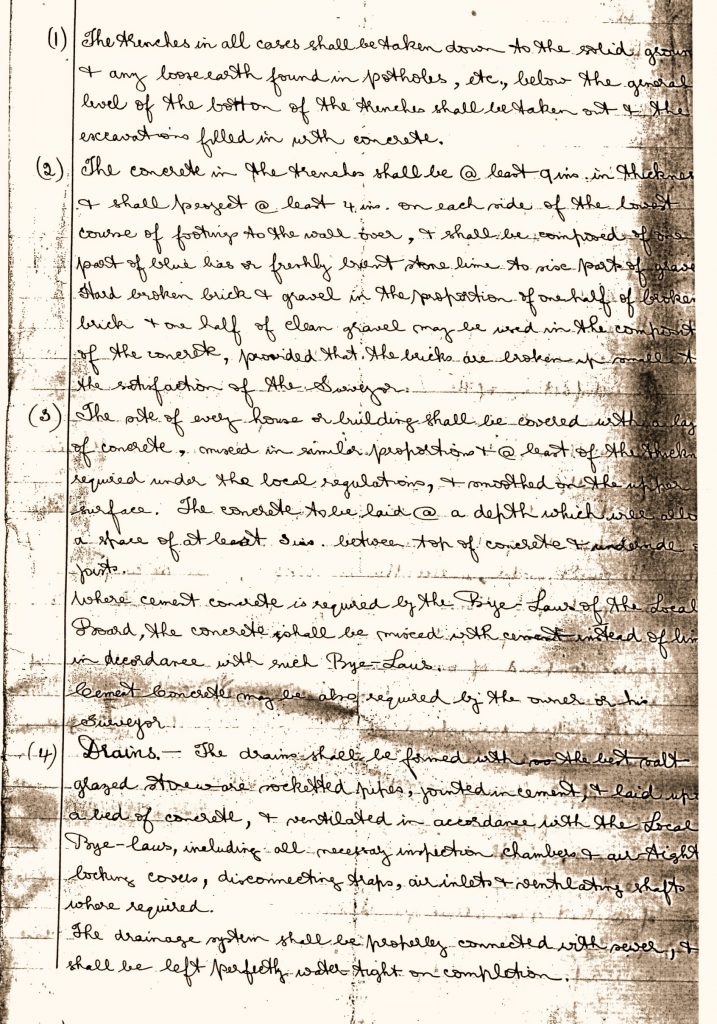
It dates from the very end of the 19th century, and goes into quite a lot of detail, including some Victorian builders’ terminology that could well have you scratching your head! Bearing that in mind, ACS member Nick Hervey has compiled a Glossary of Building Terms, which follows the main text.
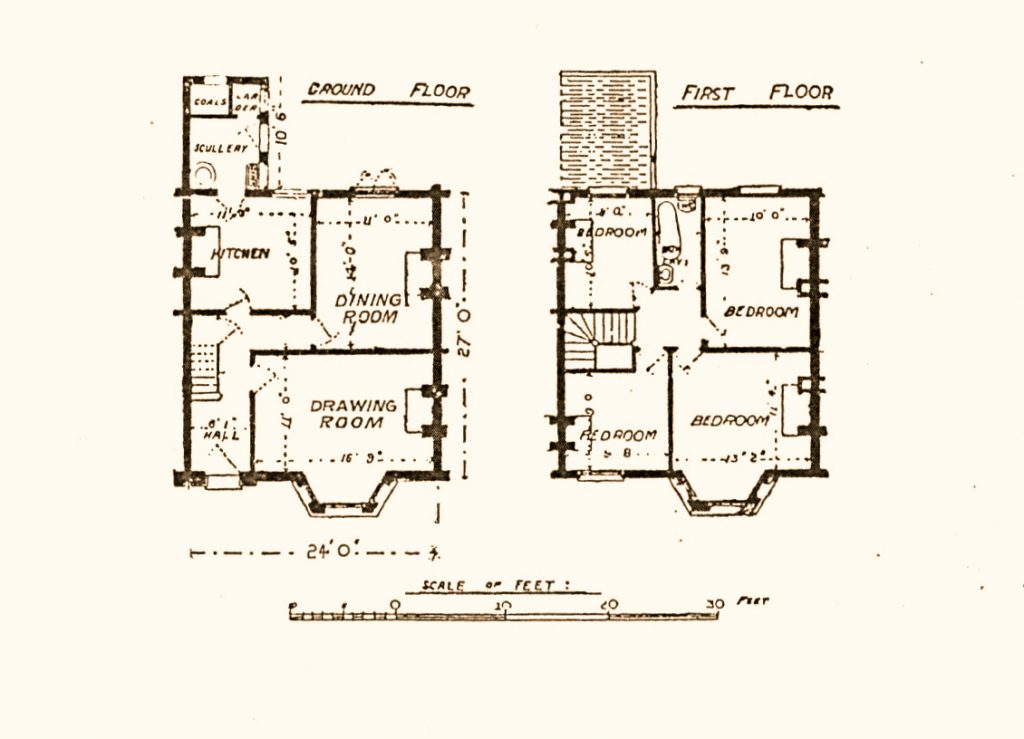
Although the Building Specification was drawn up for the 24 ft frontage houses on the Estate (which was called St Germans after the original landowner), which have 4 bedrooms, we presume that many of the ‘rules’ for constructing a Corbett House would have applied to other sizes and styles of properties on the Estate too.
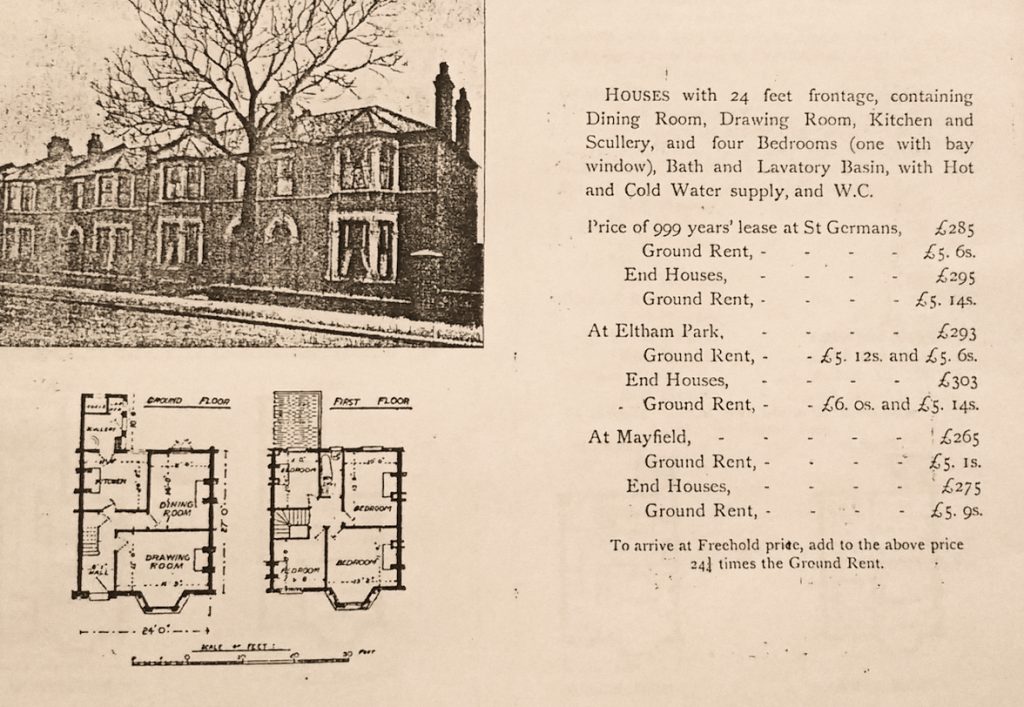
Since it was hand-written, and at times hard to decipher, we’ve transcribed the text into more readable form. Unfortunately we don’t know who the author was, but most likely he worked for Corbett in some administrative capacity, or perhaps was an in-house Surveyor.
Corbett himself was known to visit his Estate as work progressed, and would have been very keen to keep the standard of building as high as possible, so that the houses gained a good reputation and his investment was protected. Of course, he also genuinely wanted to provide decent homes, and the fact that so many are still in good condition is testament to his efforts, and to the skills of the carpenters, bricklayers, plumbers and so on who laboured for around 15 years to complete St Germans.
Below is the full Specification, with present-day photographs for illustration. It’s followed by the Glossary.
——————————————————————————————————–
SPECIFICATION AS USED ON
ST GERMANS ESTATE
(24ft frontage houses)

1. The trenches in all cases shall be taken down to the solid ground and any loose earth found in potholes, etc, below the general level of the bottom of the trenches shall be taken out and the excavations filled in with concrete.
2. The concrete in the trenches shall be at least 9 inches in thickness and shall project at least 4 inches on each side of the lowest course of the footings to the wall over, and shall be comprised of one part of Blue Lias or freshly burnt stone lime to six parts of gravel. Hard broken brick and gravel in the proportion of one half of broken brick and one half of clean gravel may be used in the composition of the concrete, provided that the bricks are broken up small to the satisfaction of the Surveyor.
3. The site of every house or building shall be covered with a layer of concrete, mixed in similar proportions and at least to the thickness required under the local regulations, and smoothed on the upper surface. The concrete to be laid at a depth which will allow a space of at least 3 inches between top of concrete and underside of joists.
Where cement concrete is required by the Bye Laws of the local Board, the concrete shall be mixed with cement instead of lime in accordance with such Bye Laws.
Cement concrete may also be required by the Owner or his Surveyor.
4. Drains: the drains shall be formed with the best salt glazed stoneware socketed pipes, jointed in cement, and laid upon a bed of concrete, and ventilated in accordance with the Local Bye-Laws, including all necessary inspection chambers and air-tight locking covers, disconnecting straps, air inlets and ventilating shafts where required.
The drainage system shall be properly connected with sewer, and shall be left perfectly watertight on completion.
5. Brickwork: no place bricks shall be used in the face of any external wall.
6. The external walls and all walls below ground and above the roofs, including the chimney stacks, shall be built with hard, first quality square, well burnt stock bricks.
Rough stocks to be used for footings and brickwork below ground.
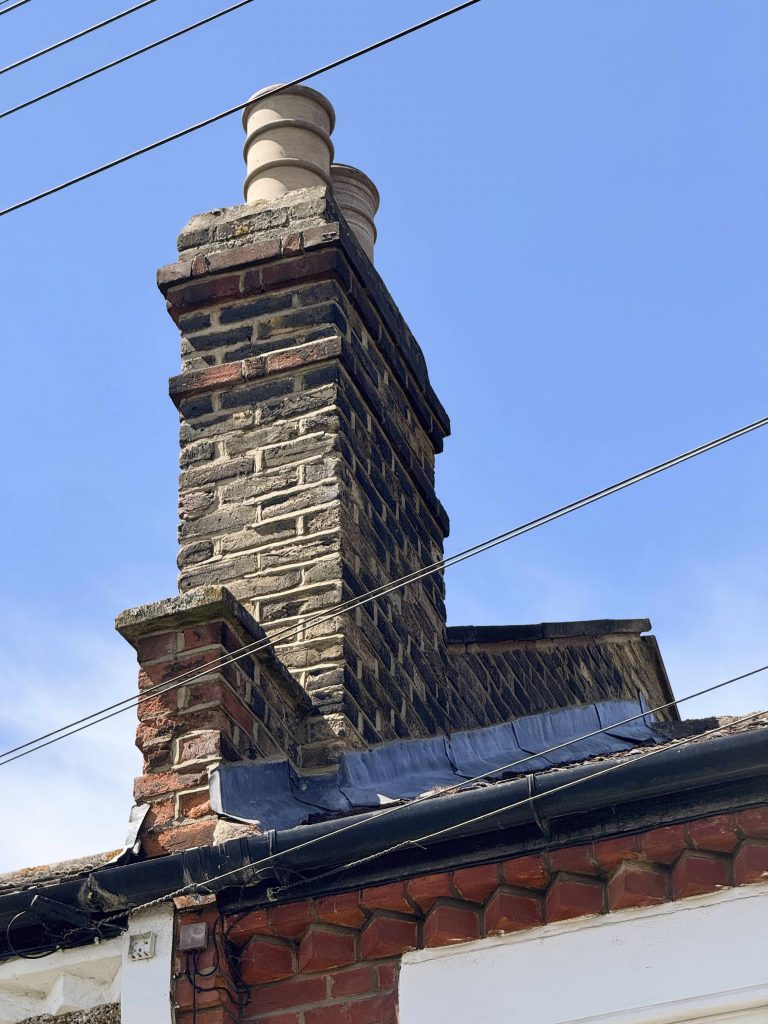
7. The top six courses of all chimney stacks shall be built in cement, all chimney pots shall be set in cement, and all weatherings, floatings and filletings shall be in cement. The brickwork of chimney stacks on flank walls where roofs are hipped off shall be carried up at least to the level of the ridge.
8. The external faces of all walls below the ground level shall be rendered impervious to moisture in the manner directed by and the satisfaction of the Local Authorities.
9. The mortar shall be composed of one part of fresh burnt stone lime to three parts of clean sharp sand or other approved grit, free from earthy matter.
Burnt ballast or broken brick may be substituted for sand or grit provided it is properly ground in a mortar mill.
10. The cement mortar, unless otherwise specified, shall be composed of one part of Portland cement to four parts of clean sharp sand.
11. Every wall or pier, internal or external, shall have a damp course composed of one course of slates laid with at least 1 inch laid in a bed of Portland cement mortar (2 +1). Such damp courses shall extend throughout the full thickness of the wall or pier and shall be laid at a level of not less than 6 inches below the level of the lowest floors, and in no case at less than 4 inches above the level of the ground.
Cement plinths shall be run around the external faces of all front walls, and shall extend from top of footings to a height of at least 9 inches above ground level.
12. Nine inch by six inch cast iron air gratings shall be built in all external walls where necessary to ventilate under floors, and all sleeper walls shall be honeycombed where necessary for access of air.
13. The top of every party wall and every parapet wall shall be coped with approved York stone coping at least 12ins wide, and not less than 2ins thick. The coping to be laid and jointed in cement.
The cills to all ground floor windows shall be of York stone not less than 3 inches in thickness, weathered and throated.
The cills of all upper windows shall be of Bath stone of good quality not less than 3 inches thick, weathered and throated.
The stone steps and landings at the front shall be of York and in no case less than 3 inches in thickness.
14. All boundary and party fence walls shall have two courses of footings laid where necessary, from the nature of the soil or the local regulations, on a bed of concrete not less than 6 inches deep, and no boundary or party fence wall shall be less than 9 inches in thickness, except in panels which shall not exceed 9 ft in length by 3 ft 6 inches high, with dividing piers not less than 3 ft on face.
The top of every boundary or party fence wall shall be finished brick or edge in cement.
15. The forecourt walls shall be 9 inches in thickness, and shall have at the least one course of footings resting where necessary, from the nature of the soil or the local regulations, upon a bed of concrete not less than 6 inches deep, and the footings and concrete shall be below ground level.
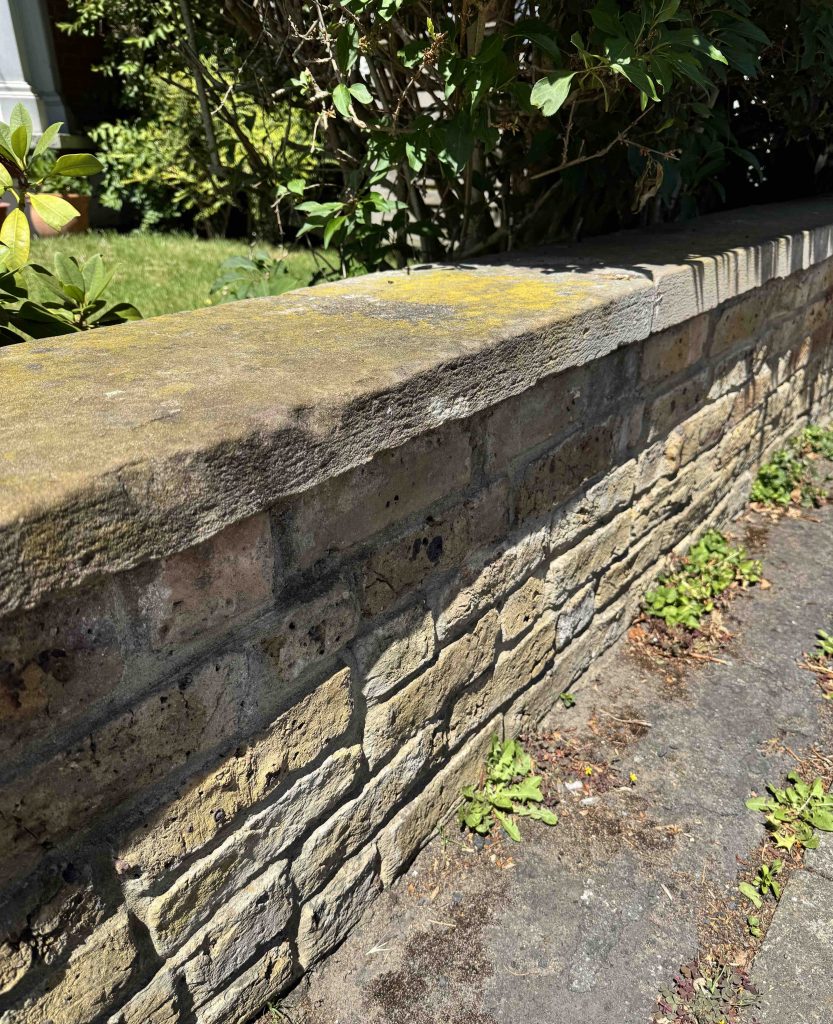
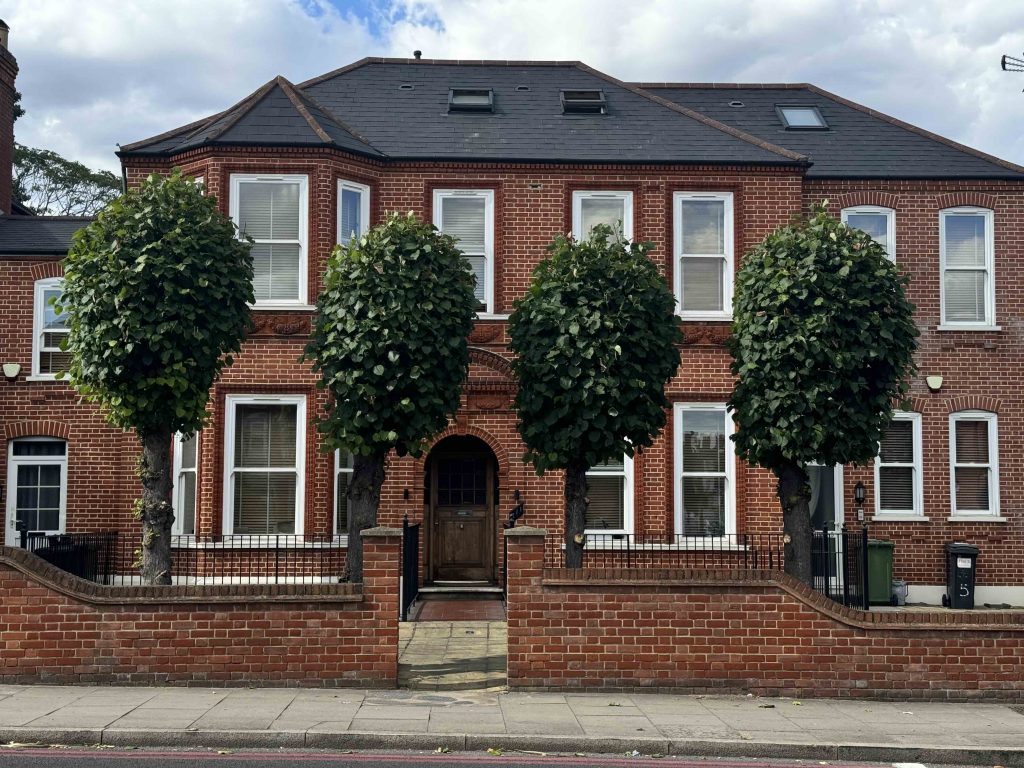
16. The piers to forecourt walls shall be built in approved red rubbers, and shall be not less than 18 inches by 18 inches piers with approved stone caps.
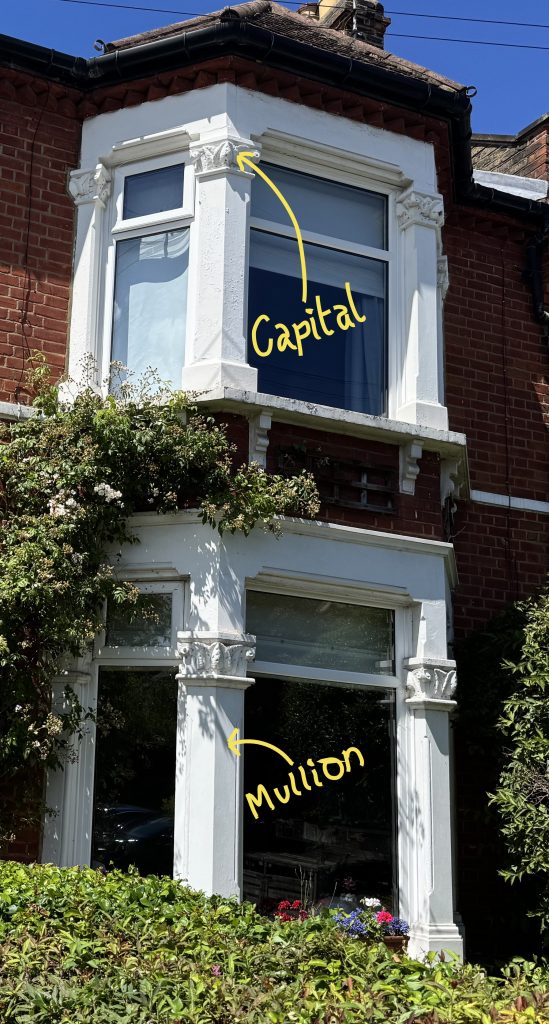
17. Stone heads, caps and mullions etc at the front shall be of best quality Bath stone, properly jointed, dowelled where necessary and dressed up as the work proceeds.
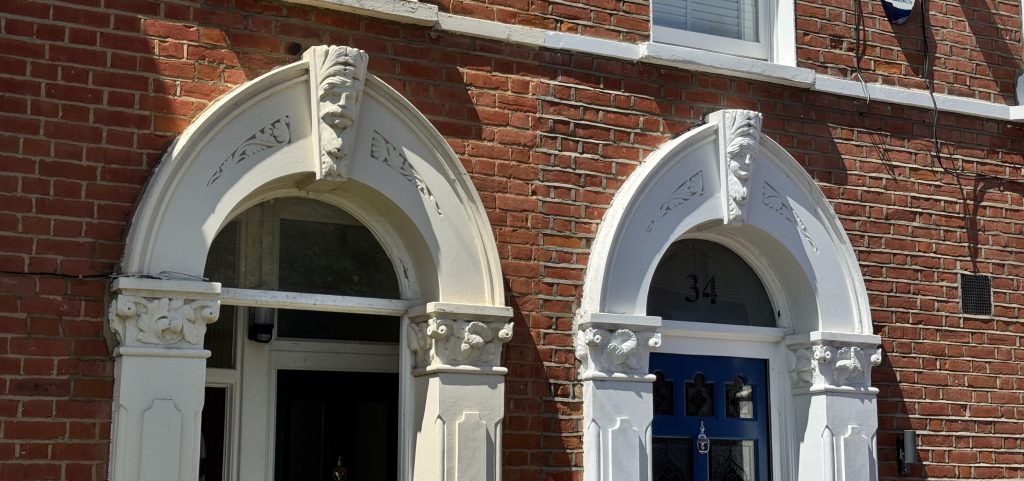
‘Caps’ refers to the Capitals – the decorated pieces of stone sitting on top of the columns on each side of the doorways and above the Mullions separating the windows in the bay
18. The faces of all front walls shall be raked out and properly pointed with lime colour to suit brickwork, and key jointed with in true upright and live courses. The other external walls to be struck as the works proceed, with neat, level and upright joints, and the work to be gone over where necessary at completion of the building.
19. No chase for pipes of any description shall be made in any wall of a less thickness than 14 inches. All gas and water pipes shall be carried up so as not to be exposed in hall, staircase or rooms.
20. The thickness of all walls shall be not less than minimum thickness allowed by the local Bye Laws.
All brickwork shall be properly bonded and solidly put together, and shall be well flushed up as the work proceeds. The mortar beds in no case to exceed 5/8ths of an inch in thick.
All partitions on ground floor between parlour and kitchens shall be half brick partitions with studs and cross pieces well nailed. The height from finished floor to ceiling shall be, for ground floor, 9ft 6 inches, and for upper floor 9ft 0 inches.
Back addition ground floor, 8 ft 6 inches.
21. The hearths shall be formed with brick trimmer arches laid in cement, or of Portland cement concrete, as may be required, and at the top of every hearth where not tiled shall be finished with float surface in cement.
22. The kitchen fireplaces shall have cement joints with chamfered edges, and the stoves and chimney pieces hereafter described shall be properly set in a workmanlike manner.
23. The scullery floors and paths of back shall be formed with a bed of cement concrete at least 4 inches thick, and shall be finished with 3/4 inch floating cement surface (2 and 1), and the paths at back shall be laid to falls and of the breadth of 4ft.
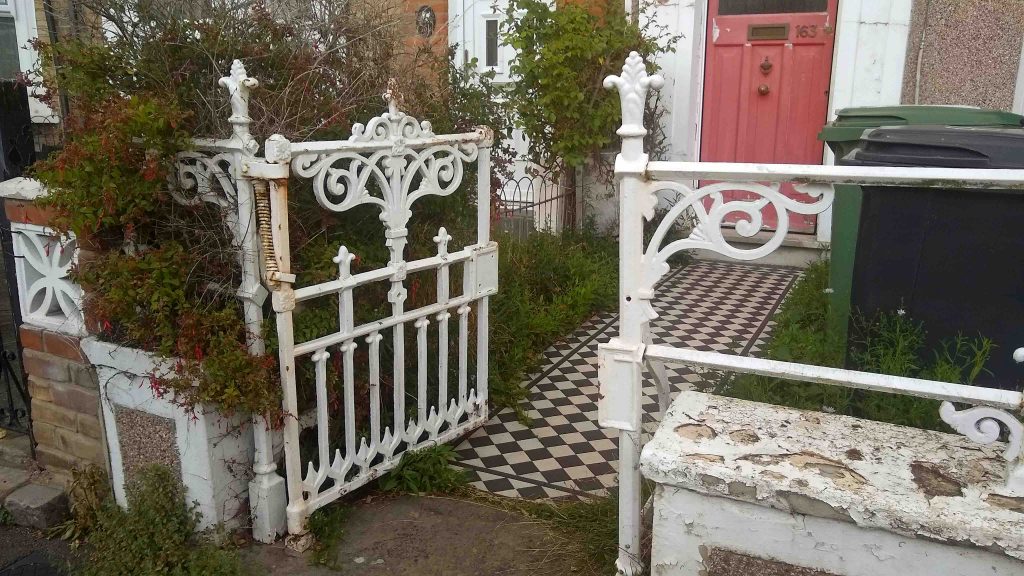
24. The paths from front gate to entrances shall be formed with a bed of cement concrete at least 6 inches think, laid to slight fall and floated on cement dressed with approved pattern and quality black and white tiles, with approved border and tile edging.


The tiling in no case shall be less than 3½ft in width inside tile edging.
25. All timbers and Deals used shall be good, sound, dry and well-seasoned, free from sap and other defects.
26. No white Deal or battens shall be used for carpenter’s work, but white Deal may be used for stair treads, strings, match boarding and upper floors.
27. No joist, rafter or ceiling joist shall be fixed more than 12 inches in the clear apart.
28. Trimmers shall in all cases be half an inch thicker that the joists trimmed into them.
29. All plates and purlins, edges or binders shall be in the strongest lengths obtainable, and where heading joists occur they are to be scarfed.
All plates shall be 3 ½ inches by 2 ½ inches and stour fir lintels shall be fixed over openings at least 1 inch deep for every foot in width of opening and not less than 4¼ inch broad.
30. All main roofs shall have a rise of at least a 1/3rd the span, and all rafters shall be in single lengths, and in all cases shall be birds mouthed over plates and well secured at the feet to the ceiling joists.
31. The ground floor joists shall not be less than 3 ½ inches by 2 ½ inches, or 4 inches by 2 inches, and at these scantlings shall not have a leaning of more than 5 ft.
4 inch by 3 inch joists may be used where the span does not exceed 9ft 4 inches.
5 inch by 2 inch may be used where the span does not exceed 9ft 4 inches.
32. No floor joist, other than ground floor joist, shall be less than 7 inches by 2 ½ inches.
33. 7 inch by 2 ½ inch joists shall be used where the span does not exceed 13 ft
34. 9 inch by 2 ½ inch joists shall be used where the span exceeds 13 ft but does not exceed 15 feet.
35. 11 inch by 2 ½ inch joists shall be used where the span exceeds 15 ft but does not exceed 18 feet.
No joist or rafter to be less than 2 inches in thickness.
36. One row of stout herringbone or solid strutting shall be fixed between the floor joists wherever the span exceeds 9ft.
37. Wooden bressummers over openings shall not be of less than the following sizes: where the bearing does not exceed
38. Where the openings are over 16ft in width steel bressummers are to be used.
39. Rafter and ceiling joists shall be of the followingscantlings: 4 inches by 2 inches; or 3 ½ by 2 ½ inches. Where the bearing of rafters exceeds 7ft they shall be strengthened by purlins and struts, and the ceiling joists shall have a binding joist on upper side where span exceeds 7ft.
40. The stud partitions shall be formed with studs 3 inches by 2 ½ inches and stud shall be more than 12 inches clear apart, and with one row of studs 5ft from the floor. No partition shall be less than 3 ½ inches in thickness when finished.
41. Purlins shall in no case be less than 6 ½ inches by 2 ½ inches and shall be strutted with struts of a scantling of not less than 3 ½ inches by 2 ½ inches in such a manner that clear bearing of the purlin shall in no case exceed 6ft. The ends of the purlins next to party walls shall be supported on corbels.

42. Tiling battens shall be of yellow deal, and shall in no case be of less than 2 inches by ¾ inches.
43. Valleys and gutters shall be lined with 1 inch yellow deal boarding with properly splayed tilting fillets.
44. Eaves, boards and ridge boards shall be of yellow Deal, and not less than 1 inch and 1 ¼ inch thick respectively.
45. All flooring shall be prepared flooring 7/8th inch thick finished thickness, and shall be well clamped up or laid folding.
46. All framed doors shall be made from yellow Deal, and shall be of the sizes and thicknesses specified, viz:
· Front door to be similar to those generally in use with 21ft class of house on the St Germans Estate
· Parlour doors 6ft 8 inches by 2ft 8 inches by 2 inches, panelled and moulded both sides.
· Kitchen doors 6ft 6 inches by 2ft 6 inches by 1 ½ inches, panelled and moulded and coloured marginal light
· Back doors 6ft 6 inches by 2 ft 6 inches by 1 ½ inches, bead and butt and square framed, and upper panels prepared for glass, hung to 5 inch by 3 inch frames, and 5/8th inch by 3 inches beaded stops.
· Cupboard and W.C. doors 6ft 6 inches by 2ft 6 inches by 1 ¼ inches, panelled and moulded one side.
· Bedroom doors 6ft 6 inches by 2ft 6 inches by 1 ½ inches, panelled and moulded both sides.
47. French casement doors shall each be 6ft 10 inches by 1ft 6 inches by 2 inches, panelled and moulded and rebated doors with fanlight over in 5 inch by 3 inch solid wrot rebated and beaded fir frames, and 6 inches by 3 inches oak cills.
Kitchen, pantry and scullery doors may be moulded or solid, but all other doors to be planted.
48. All linings round internal doors shall be 1 ¼ inches thick when finished, and stops shall be not less than ½ inch in thickness.
49. All sashes to back elevations shall be ovolo moulded, 1 ¾ inches thick when finished, and have moulded horns to upper sashes, and shall be properly hung to deal-cased frames with ¾ inch linings, ¾ inch inner linings and 1 inch pulley styles, all properly framed together, and to the cills.
50. The architraves round doors and window openings shall be approved yellow Deal architraves 2 ¾ inches by 1 inch, clean dressed, ½ inch by 5 inch yellow Deal architrave plates on hall and parlour doors.
51. All staircases shall be 2ft 10ins wide, and shall have treads out of 1¼in yellow or white deal, ¾ risers properly housed to 1¼in yellow or white deal wall and outer strings, and all shall be properly tongued together, and glued, blocked and bracketed.
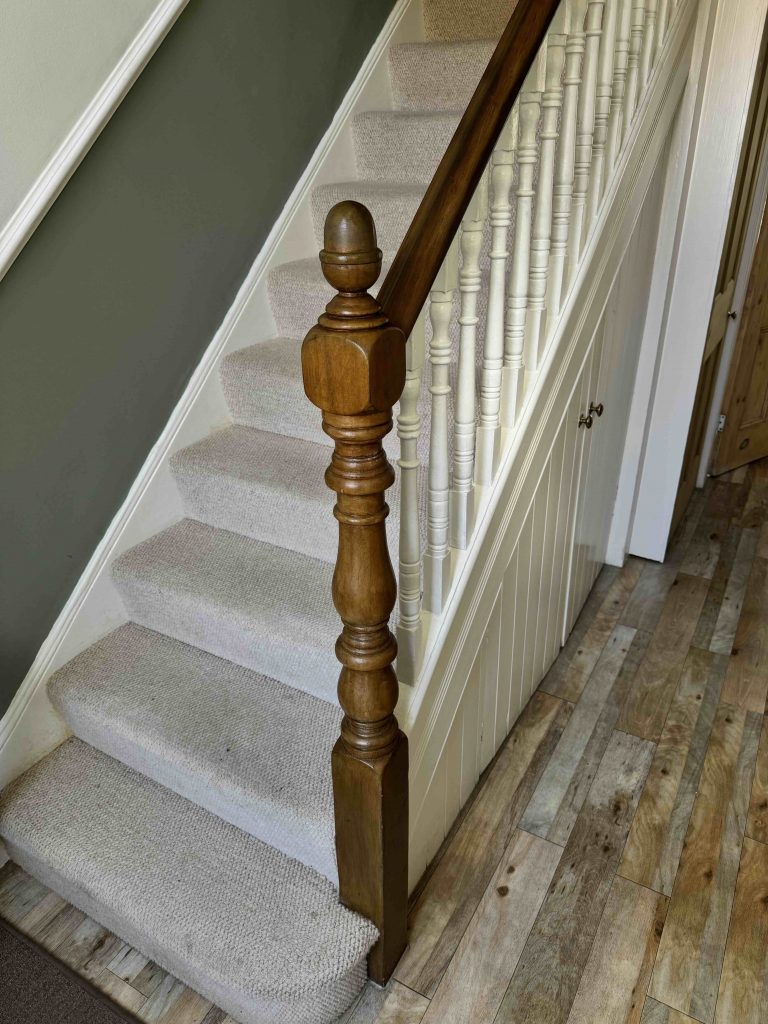
The spandril filling shall be 5/8in matchboarding, fixed to 3in by 2in framing.
52. Window boards in all cases shall be at least 1¼in finished thickness and shall have rounded endings. The framing of dresser and cupboards and the dresser tops shall be formed out of 1¼in stuff. The kitchen mantle-shelf shall be formed out of 1½in stuff. The cupboard pantry and lower dresser shelves shall be 1in thick, and if jointed must be tongued and grooved.
53. All handrails shall be approved moulded mahogany not less than 4½ins x by ½ins with yellow deal rail under-grooved to received balusters, newels shall [plain square newels] be of mahogany not less than 4½ins x 4½ins; newels on upper floors may be of yellow deal, 4½ins x 4½ins and balusters shall not be less than 10ins x 2ins [alternatively the 2in balusters to have small (…) yellow deal or pitch-pine, and fixed two to each tread. Under stair to be neatly finished as cupboard or recess with door either from Kitchen or passage as required.
54. The skirtings in the two parlours shall be 9ins by 1in approved moulded; in front bedroom 9in x 1in; and in the other rooms shall be 6 ins x 1in plain square.
55. The fences at back shall be close boarded fences formed with oak fixed not more than 8ft apart, the posts to be at the least 6 ft in length shall be securely fixed; ¾in feather edge boarding shall be yellow deal rails not less than 4ins x 3ins and the fences between the back additions shall be ¾in close-boarded fences, not less than six ft in height with similar posts and rails. Back fences ¾in close boardings.
56. The roof shall be covered with approved quality Welsh Countess or Marchioness slating (20ins x 10ins or 22 ins x 11ins) laid to not less than 2½ins overlap, each slate shall be nailed with two galvanised metal nails; zinc soakers shall be fixed to party walls and chimney stacks.
57. The ridges and lips shall be covered with approved tile ridging with not less than 5in wings, and bedded in plaster and jointed in coloured putty and fixed with screws.
58. The front eaves guttering shall be of No.12 zinc, moulded to pattern. The lips and flashing to roofs over bay windows shall be formed with 5lb lead, properly dressed over tilting fillets, and all lips to be at least 4ins. Valleys to be of no.12 zinc.
59. The back eaves guttering shall be of 6ins x 3ins O G pattern cast iron guttering, properly screwed to eaves board, with cast iron stop end where necessary.
60. All rain pipes shall be of iron not less than 2 ins diameter and shall have all necessary swan necks, bends etc, and each pipe to have shoe at foot and be carried to outlet to drain or gulley as required by Local Authority.
The rain-water pipe to small addition at rear shall be 2 in diameter iron pipes with shoe at foot or discharged as approved by Local Authority.
61. Soil pipes (including ventilation ends) to be of iron 4ins diameter well jointed with caulked lead joints.
62. The railings to forecourt walls shall be cast iron, heavy butterfly pattern railing as heretofore, with gate with locking latch to match, and shall be properly set in the stone coping to forecourt walls and in the stone landing next pavement.
63. The stoves and ranges shall be obtained from approved makers only or may be supplied by owner and charged at cost to builder.
64. The two parlours shall be fitted with approved pattern register stove, 36in wide, with canopy and tiled cheeks, of not less value than 17/6 each prime cost
65. The chimney pieces in two parlours shall be approved pattern Sicilian marble chimney piece, with 10in piers (and of not less value than 32/- prime cost) or may be of wood of the same value as required, and shall have approved tile hearths marble curls as heretofore.
The best two bedrooms shall be fitted with 42in approved pattern iron mantle register stoves of value of not less than 16/- each prime cost, and the back room shall be fitted with 20in approved pattern iron mantle register stove of a value not less than 6/- each prime cost.
66. The kitchen fireplaces shall be fitted pattern 36in kitchen ranges, plates of kitcheners to be at least ¼in thick, and ash trays to have sheet-iron sides, bottom and back at 1/16 in thick, and the kitchener shall be of not less value than £4 2/- 9d prime cost, including pressure boiler.
67. The coppers shall be provided with strong galvanized iron pans, not less than 10-gallon size, and approved fire-boxes and fittings completes.
68. The bath shall be 66in approved second quality Roman Baths of not less value than __________ net, properly connected with hot and cold supply, and with approved ¾in brass draw-off cock, having 3/8in stem. The sinks shall be approved Cliff glazed stoneware sinks, not less than 30in by 15 in by 6 in deep; and draw-offs shall be approved ¾in brass draw-off cocks. All hot water draw offs to be of gun metal with star top.
The lavatory basins shall be not less than 24in x 15in approved pattern with upright ledge on sides and back properly connected with hot & cold supply and with approved brass fittings.
69. The cisterns shall be of galvanized iron, of at least no. 14 gauge, and shall hold at the least 80 gallons, and the connections between pipes and cisterns shall in all cases be made with 5/8in core brass boiler screws, having union and double nuts. All cisterns shall have approved covers.
70. The hot water pipes shall be of strong steam piping, the main flow and return between boiler and hot water cistern shall be in no case less than 1½in piping, and no branch shall be formed with less than 2/4in piping.
All to be properly connected with draw-offs, and no square elbows shall be used.
71. The hot water cisterns shall be 3/16in plate galvanized iron, and shall hold at least 25 gallons. The whole shall be properly jointed together with joints screwed up with hemp and red lead, and the hot water service left in through working order at completion.
72. The supply pipes from main to supply cistern shall be ½in bore lead piping of a weight not less than 30lbs per 15ft, and the piping from cistern to sinks etc. shall be ½in bore lead piping not less than 25lbs per 15ft; all joints to be proper wiped solder joints.
73. The overflow pipes from cisterns and water-waste preventers shall not be less than ¾in bore lead piping, and the waste pipes from baths, and the flush pipes between WC’s and water-waste preventers shall be not less than 1¼in bore lead piping; weight 36lbs per 12ft.
74. All waste pipes shall be properly trapped as close to the underside of fitting as possible and shall discharge outside over open gullies.
75. The water closets shall be approved pattern pedestal wash-down closets properly trapped, with 1in mahogany seats hung on brass Critts, and with approved pattern 2 gallon cast iron waste water preventers, with chain and handle complete.
76. The gas tubing throughout shall be of wrought-iron welded tubing, and no composition piping shall be used; the mains shall be ¾in diameter, and no branch shall be less than 3/8th bore for more than one burner.
All the gas piping shall be properly and carefully connected together with all necessary elbows, bends, T-pieces, connections and diminishing pieces, and shall be properly tested at completion. No piping shall be left exposed except in kitchen, scullery and bathroom.
77. The gas fittings shall in all cases be of approved quality and patterns, and chadeliers shall be 3-light and steel, bronze or brass with ¾in stem and 26ins at the least from light to light.
The bedrooms shall be fitted with 12in swing brass cable tube or other approved brackets.
The bathrooms, W.C.s and sculleries shall be fitted cock-up stiff brass or other approved brackets.
The kitchen shall be fitted with approved 1-light slide pendants, outer pipe, ¾in.
The hall lamp shall be approved 7in square-leaded, light brass-framed lamp.
The brackets shall all be fixed to approved moulded wall blocks and screwed with brass screws. [NOTE:This paragraph has marked against it ‘omit’ although it wasn’t crossed out]
78. All laths shall be split laths, sound and free from roof, and shall be nailed with 1in nails.
The key shall be in no case more than ¼in, and joints to be broken every 3ft.
79. Plaster, float and set all lath partitions, and render float and set all walls; no two coats work shall be allowed.
80. The plastering or coarse stuff shall be composed of freshly burned stone lime and clean sharp sand or grit, free from earthy matter, properly mixed with clean water, in the proportions of one of lime to three of sand or grit, and shall be mixed with long clean cow hair in the proportions of 1lb of hair to every 3 cubic feet of the other material. The fine stuff shall be carefully slaked lime no sand and a small proportion of hair.
81. The setting coat shall be composed of lime or cement, no sand; and all angles shall be run in gauged stuff.
The scullery walls shall be rendered and set in cement to a height of at least 4ft 6ins.
82. Approved plaster moulded cornices, not less than 24ins. Diameter shall be fixed in two parlours and approved centre flowers in hall, not less than 10ins diameter.
83. All glass shall be free from blemishes.
The sashes above 5 square feet in area shall be properly glazed with 21oz sheet glass; sashes under 5 square feet may be glazed with 15oz sheet glass.
The front doors shall be glazed with approved pattern and quality lead lights, the bathroom window and half glazed doors at back shall be glazed with approved pattern obscured glass of the thickness above described.
84. Painter – all ironwork shall have one coat of good oil colour before fixing and one coat after fixing.
85. All woodwork shall have three coats of good oil colour, and shall be grained and twice varnished throughout unless otherwise directed, if painted only to have 4 coats.
86. All mahogany work shall be French polished.
87. Paper hanger – The wall papers to be carefully hung with the patterns matched. The papering of halls, staircases and landings, and in kitchens and bathrooms shall be twice sized and once varnished.
88. These papers shall be of approved patterns and of the following values:-
i. Front bedrooms ………….1/- per piece net
ii. Back bedrooms …………..9d per piece net
iii. Parlours ………………………1/3 per piece net with dado to match
iv. Halls & staircases ………. 1/- per piece net
v. Kitchens & bathrooms.…9d per piece net
89. The locks & doors & window furniture shall be all of approved quality and makes. All Critts shall be wrot Critts.
The front doors shall be fitted with 4ins night latch, one brass knocker, brass postal handle and letter plate combined, one japanned chain and two bright barrel bolts, and hung on one pair of 4in bolts; all 2in doors shall be hung on 4in bolts, except small cupboard and dresser doors, which may be hung on 2½in bolts.

The two parlour doors shall be fitted with 5 in mortice locks, with white china furniture, and two white china plates.

The kitchen , scullery and bedroom doors shall be fitted with 6in rim locks, with brass furniture.
The cupboard doors shall have 6in rim lock, with strong brass furniture, and two 9in barrel bolts.
The dressers shall have brass or japanned drawer handles and no. 20 stout brass cupboard hooks.
The windows shall be fitted with approved strong brass sash fasteners, and each of the lower sashes are to be fitted with approved brass sashlifts.
The folding doors shall fitted with half-rebated mortice locks 9ins x 6ins brass flush bolts, and white china furniture and finger plates.
90. The windows of the front parlours and of each of the bedrooms & bathrooms shall be fitted with venetian blinds, with tapes, cords and fastenings complete.
91. All rubbish shall be cleared away at completion, floors scrubbed and windows cleaned.
All stoves and ranges shall be blacked, brass furniture polished and gas and other fittings, and the houses shall be left in a perfectly clean and finished condition.
92. The front and back gardens to be cleared of weeds etc. and dug; gravel paths to be formed, and the gardens at front to be laid out, turfed, and planted with limes and laurels.
93. The London Building Act and Bye-Laws, the Bye-Laws of the Local Authorities & the Public Health Acts, shall be carefully conformed to, and the foregoing schedule is in no way to relieve the contractor from any of their provisions or requirements, or from attending and observing as within his contract all instructions or notices from the authorities concerned, and payment of their fees.
The contractor shall deliver up the Houses complete and perfect in every respect to the satisfaction of the owner or his surveyor, and shall make good any defects that they may require either before or after the purchase so completed, if said defects are in the opinion of the surveyor due to defective construction.
The foregoing schedule is not to be held as containing everything required for the houses, but is explanatory of the work & fittings at present required for the houses of this class and the houses must be fully equal in every respect to those built for the Corbett Estate of similar value whether everything necessary for this purpose is above-mentioned or not.
——————————————————————————————————–
GLOSSARY OF TERMS USED IN THE BUILDERS’ SPECIFICATION
BALUSTER – a baluster is a vertical support, post, or “spindle” that sits between the bottom runner and the handrail of a staircase, porch, or balcony. A collection of these evenly spaced vertical posts supporting a single railing is referred to as a balustrade.
BIRDS MOUTHED – Birdsmouthing refers to a V-shaped notch cut into the rafter to allow it to sit flat and flush against the timber wall plate.
BLUE LIAS – a binder for the concrete mix which was on a 1-to-6 ratio. It called for 1 part of either Blue Lias (a highly durable, hydraulic lime) or freshly burnt stone lime, mixed with 6 parts of aggregate. Typically the aggregate was a blend calling for hard broken brick and gravel mixed in equal parts.
BRESSUMMER – Steel bressummers (aka lintels or support beams) are required for wide structural openings to safely transfer loads from upper floors or roofs. While the general rule states steel is needed for openings over 16ft, modern building standards rely on precise engineering calculations to determine the exact beam size and material for the specific span and load.
CAPS – short for Capitals (from the Latin caput, meaning head), which are (often decorated) pieces of stone sitting on top of columns, mullions and piers. They broadened the area of the column’s supporting surface. When set at the top of piers [pillars] for front garden entrances they had to be of weathered or twice-weathered stone. This prevented rainwater from absorbing directly into the brickwork, avoiding long-term degradation and freeze-thaw damage.
CLIFF GLAZED STONEWARE SINKS – refers to traditional, heavy-duty fireclay or salt-glazed stoneware sinks historically manufactured by the English heritage firm Cliff & Sons (based in Wortley, near Leeds).
COPED – this building regulation required exposed party and parapet walls to be capped [or coped] with durable natural stone. The masonry must be bedded and firmly pointed using a strong, weather-resistant cement mortar to prevent rainwater ingress, dampness, and costly freeze-thaw decay. York stone was specified because it is a dense, hard-wearing British sandstone highly resistant to the our fluctuating weather conditions.
COPPERS – a wash copper was a laundry boiler. These built-in, coal-fired units were used to boil water for washing clothes and linen before the advent of modern washing machines.
CORBELS – A corbel is a solid structural bracket that projects outwards from a wall to support a heavy weight (such as a balcony, roof eaves or a beam). While traditionally functional, they were frequently used purely as ornamental design features on interior and exterior walls.
COUNTESS AND MARCHIONESS SLATES – refer to traditional imperial dimensions for natural roofing slates. These names were originally coined in the late 1730s by General Sir Hugh Warburton (owner of the Penrhyn estate) to replace confusing quarry measurements.
CRITS -archaic plumbing term for the heavy-duty brass hinges or brackets used to attach the heavy wooden seat to the ceramic bowl of a toilet [derived from a firm Crittall which supplied the item. Crittall was a brand famously known for its steel windows and internal doors, not toilets. However, the term became synonymous with black metal-framed aesthetics in bathroom design.
DEAL – Deal wasn’t produced from a single tree species, but rather was an old trade term to describe timber cut from softwood trees like pine and spruce. It was introduced when sawn boards were first imported to the UK from Northern Europe in the late C18th, and primarily refers to Scots Pine or Norway Spruce.
FILIME COST – is a historic building contract term meaning that the file-finished or custom-carved labor value should be no less than a certain amount per piece.
FIRST QUALITY SQUARE WELL-BURNT STOCK BRICKS – these are premium kiln-fired bricks chosen for their resistance to weathering, frost, and structural wear.
GOOD OIL COLOUR – refers to the primer coat which was typically a lead-based or red iron-oxide paint, mixed with boiled linseed oil. It was meant to penetrate the porous iron surface and bond directly with the metal, before the second coat.
GUN METAL DRAW-OFFS – Gunmetal draw-offs are highly specialized plumbing components. Nowadays “star top” (crosshead) draw-offs or bib taps are typically sourced from traditional or architectural brassware specialists, as standard domestic plumbing hardware usually uses levers.
HALF REBATED MORTICE LOCKS – rebated and half-rebated mortice locks are designed for double doors (like French doors) where one door overlaps the other. While “full rebate” kits step the entire lock faceplate, “half-rebated” designs fit snugly into a partial step cut into the leading edge of the door, allowing the doors to sit flush when closed.
HEMP AND RED LEAD – a Victorian old-school plumbing or pipe-fitting technique used to create watertight and airtight seals in threaded metal pipework. Plumber’s hemp (or flax) is a natural, fibrous string. It was wrapped around the male threads of a pipe in a clockwise direction. The red lead – a paste or sealant made of linseed oil and lead oxide powder was applied over the hemp. When the two pipes were threaded and screwed together at the joint, the hemp and red lead were compressed into the thread grooves, locking and sealing the connection’
HIPPED ROOFS – If the roof is hipped off (slopes downward rather than ending in a vertical wall), the wall must follow that slope and reach at least to the level of the roof’s ridge.
HUMMELS – generally refers to timber wedges, used to level out and support flooring. The specific wording here was designed to ensure that these wood shims are physically robust enough to bite into, allowing the joists to be firmly secured without splitting.
JAPENNED CHAIN – a mild steel chain coated in a glossy, weather-resistant black lacquer. Historically used to imitate Asian lacquerware, this finish provided an elegant, discreet look suited for these period properties, but also for garden projects and traditional interior ironwork.
KITCHENER -another name for a range.
KITCHENER PLATES – these were vintage cast-iron top-plates or hotplates originally designed for the iconic 19th-century Flavel Kitchener Range. In a Victorian builders specification these plates refer to the heavy metal cooking surfaces directly exposed to coal heat, which later inspired the enduring brand name Rangemaster Kitchener Cookers. Originally introduced in 1830 by William Flavel, the Kitchener range allowed Victorians to bake, boil, and roast simultaneously using a single coal fire. The solid, removable cast-iron Kitchener plates sat directly over the grate
OVOLO MOULDED – the glazing bars and timber edges of the window sashes feature a classic rounded, convex profile with a small step.
PEDESTAL WASH DOWN CLOSETS – refers to traditional or vintage-style water closets featuring a floor-mounted pedestal. They rely on a direct “wash-down” gravity flush that pushes waste out. These specific historic units are primarily found in reclamation yards or antique-style reproduction.
PIETS – refers to the jambs and lintel (the vertical legs and horizontal top beam) that form a fireplace’s front.
PLACE BRICKS – are lower-quality, often under-fired or porous bricks traditionally used for internal backing and hidden structural work. The general rule dictated that these inferior bricks couldn’t be used for the outer visible leaf of an external wall because they lacked the necessary weather, frost, and salt resistance
PLANTED – in relation to doors – referring to planted mouldings, or a specific decorative application.
PLASTER, FLOAT AND SET – This specification dictates a traditional three-stage plastering method to ensure robust, level, and crack-free surfaces. Single-coat or “two-coat work” is prohibited. Every partition and wall must be fully built up, flattened, and smoothly finished using a structured multi-layer approach.
Wood or metal laths are first covered with a base coat (plaster) to form a key, then “floated” with a levelling coat (screeded flat), and finally “set” with a thin, smooth finishing coat.
PURLINS – horizontal beams that provide intermediate support for roof rafters. They must be in the longest continuous lengths possible to safely bear the roof loads over the span.
RED RUBBERS – These were premium, high-quality facing bricks (traditionally handmade from fine, soft red clay) that can be easily cut or rubbed to form precise shapes and smooth faces. They were typically used for superior aesthetic finishes.
SALT GLAZED STONEWARE PIPES – these were vitrified clay pipes. They were incredibly durable, acid-resistant, and chemically stable for underground foul water or combined sewage networks. The salt glazing created a glassy interior, allowing waste and wastewater to flow efficiently without building up blockages.
SCANTLINGS – refers to the specific dimensions, size, and cross-sectional measurements of building materials, such as timber or stone, or the structural components themselves. In both carpentry and shipbuilding, they dictate the structural strength and thickness required for a safe build.
SCARFED OR SCARFING – Scarfing is a versatile term that refers to a specialized woodworking/metalworking technique for joining materials end-to-end smoothly. It allows you to create a single, continuous piece that retains its strength and thickness without an enlarged joint.
SHIMS – Wood shims (often referred to as packers or wedges) are essential for levelling.
SHOE – A “shoe” at the foot of a pipe refers to an exterior fitting at the bottom of a vertical downpipe (like a rainwater or plumbing pipe). It functions as a curved, outward-facing elbow that channels water safely away from the building’s foundation to prevent dampness and erosion.
SOAKERS – often referred to as ‘soaker flashings,’ are small, individual pieces of watertight material – traditionally soft-rolled lead – interleaved between slates or plain clay tiles where the roof slope meets a vertical wall or chimney.
SPANDREL – a spandrel is the specific term for the triangular space underneath a staircase. While most people just call it the “under-stair” space or an under-stair closet, a spandrel refers strictly to the void itself, or the panelling that encloses it.
SPLAYED – angled
SPLIT LATHS –also known as riven laths, refer to narrow, hand-split lengths of timber (usually oak or sweet chestnut) used in traditional lath and plaster work.
STRUCK POINTING – when mortar is “struck,” it is shaped and smoothed, as the bricklaying progresses.
THROATED – a small groove or cut-out (drip detail) is carved into the underside of the sill. This breaks the surface tension of the water, forcing it to drop to the ground rather than running back along the masonry and causing damp stains on the wall below.
TILTING FILLETS – is a wedge-shaped or triangular strip of timber fixed to the rafters at the eaves. It raises the bottom edge of roof slates or tiles to ensure they lie perfectly parallel to the rest of the roof, preventing sagging and keeping water properly shedding into the gutter.
TRIMMER ARCHES – Brick trimmer arches were laid in cement – a structural technique where bricks are laid in a curved (arched) shape to span the space between floor joists, creating a strong, fireproof platform
VALLEYS – were constructed to effectively channel water into the broader drainage system
WALL AND OUTER STRINGS – the diagonal support boards on the staircase. The “wall string” is fixed against the wall, while the “outer string” (or outer carriage) is exposed and supports the open side of the stairs.
WATER WASTE PREVENTER – a water-waste preventer was a mandated Victorian plumbing cistern designed to prevent continuous water wastage. Following the Metropolis Water Act of 1871, these high-level cast-iron or wood cisterns used mechanical siphons and ballcocks to discharge a fixed, limited volume of water per flush, stopping users from letting water run continuously. Because mains water was continuously pressurized and piped directly into individual properties, these devices were critical for preventing widespread leaks, structural water damage, and drainage of the municipal supply. Pioneers like Thomas Crapper (via the Giblin patent) popularized the, “Silent Valveless Water Waste Preventer.” These reduced moving parts and eliminated the noisy gurgling and hissing associated with earlier cisterns.
WEATHERINGS AND FLOATINGS – these are the protective, sloped layers of mortar or render at the top of the stack (like the capping or flaunching) designed to shed rainwater quickly away from the flues and prevent water ingress.
WINDOW FURNITURE – (or window ironmongery) refers to all the operational hardware attached to a window. This primarily included fitch or Brighton fasteners for locking, sash lifts for raising the windows, and pulleys for the counterweight systems.
WIPED SOLDER JOINT – a traditional plumbing technique where a large mass of molten solder is poured onto or around a pipe joint and physically shaped, or “wiped,” by hand using a cloth (like moleskin) before it solidifies, which ensures the plumbing is leak free and prevents long-term corrosion.
WROT – Victorian builder speak for wrought – as in wrought iron